
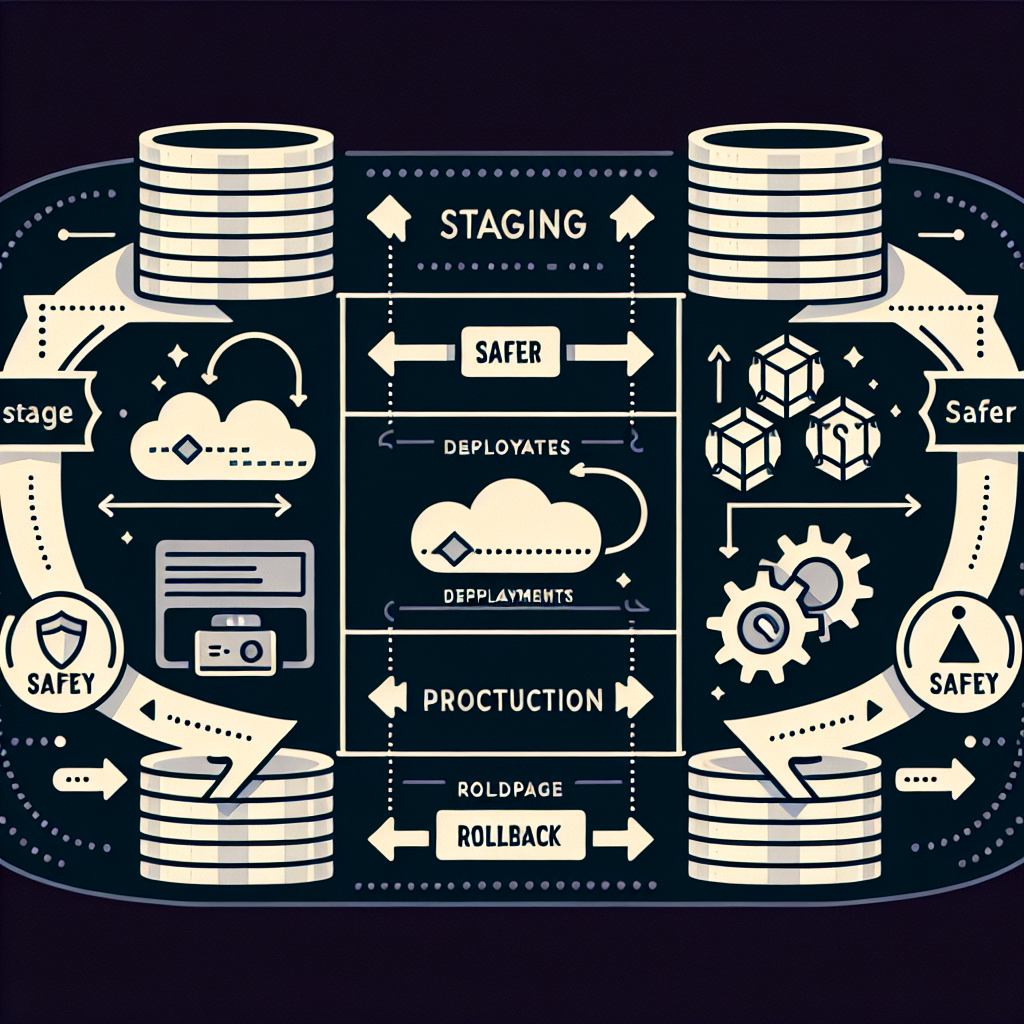

How often have you released a change that behaved perfectly in staging only to surprise you in production? That gap between expectation and reality is where most delivery risk hides. Closing it is not about luck; it is about engineering the path from staging to production so that deployments are boring, rollbacks are fast, and users never notice you shipped.
This article dives into the practical differences between staging and production, the patterns that reduce release risk, and the habits that make reversibility a first-class design goal. Whether you run a monolith or dozens of microservices, the principles here scale across architectures and teams.
By the end, you will be able to choose the right strategy for a given change, know how to validate it safely, and recover quickly when reality diverges from plan. That is how elite teams ship fast without breaking things.
What Staging Is—and What It Isn’t
Staging is a production-like environment where you validate that a build is deployable and behaves as intended under conditions that approximate reality. The closer staging is to production in infrastructure, configuration, and data shape, the more trustworthy your results. Think immutable artifacts, the same container images, the same IaC templates, and the same service mesh configuration, not a separate snowflake stack that drifts with time.
However, staging is not a perfect mirror. Traffic volume, user behavior, and third-party systems rarely match one-for-one. Over time, configuration drift creeps in, mock services age, and test data grows stale. If you treat staging as an oracle, it will eventually surprise you. Instead, consider it a rehearsal that reduces risk—but never replaces production validation with guardrails.
To improve fidelity, invest in masked production data snapshots, synthetic traffic replays, and contract tests for external integrations. Practice build once, deploy many: the exact artifact you verify in staging must be the one you promote to production. Automate environment provisioning to minimize drift, and audit configuration deltas regularly.
Data parity and test realism
Realistic data is often the missing ingredient. Schemas, cardinalities, and edge cases in production data can invalidate freshly green builds. Use sampling pipelines that copy a subset of production records into staging while applying masking and anonymization to meet privacy obligations. Aim to preserve data distribution, not specific identities.
Design tests to exercise stateful flows—long-lived sessions, retries, and idempotency—because that is where subtle defects hide. If you rely on third parties, use contract tests and service virtualization that closely mirror the provider’s behaviors, including timeouts, rate limits, and intermittent failures.
Finally, keep schema versions aligned. Version your database and message contracts, and enforce compatibility checks at CI time. If contracts diverge, staging may pass while production fails at runtime, especially in event-driven systems.
Production Realities You Must Design For
Production is a different planet: real users, unpredictable traffic spikes, and noisy neighbors. Your deployment plan must account for tail latencies, multi-region topology, and cascading failures. The steady-state you see in staging rarely reflects the P95 and P99 behavior under load, which is what users feel.
Plan for failure as a first-class scenario. Build with timeouts, circuit breakers, bulkheads, and backpressure. Assume dependencies can slow down or go away. Validate that your application degrades gracefully and that your platform can shed load without falling over.
Make risk visible. Instrument your services so you can answer, in minutes, whether a new version is healthier than the previous one. Without observable signals, deployment decisions become guesswork and rollbacks are delayed.
Observability and SLOs that inform releases
Attach releases to Service Level Objectives (SLOs). Define user-centric goals like request success rate, latency budgets, and error budgets. If a canary consumes the error budget too quickly, automation should halt the rollout and trigger a rollback without waiting for a meeting.
Collect the “golden signals”: latency, traffic, errors, and saturation. Pair them with domain metrics—checkout success, sign-in rate, or ingestion throughput. Use distributed tracing to spot version-specific regressions in critical spans. Make deployment dashboards first-class artifacts next to your pipelines.
Most importantly, predefine rollback criteria. Write them down as guardrails that your pipeline enforces. The fastest rollback is the one that happens automatically because your system knew what “bad” looked like ahead of time.
Safer Deployment Patterns
Modern release engineering offers proven patterns that limit blast radius and increase confidence. These include blue/green switches, rolling updates, canary releases, and feature-flag–driven progressive delivery. They embody the core ideas of continuous delivery: small, frequent, and reversible changes validated in production with real signals.
In a blue/green deployment, you run two production-ready environments. You deploy to the idle color, validate via smoke tests and health checks, then switch traffic. If something goes wrong, you flip back immediately. The switch is near-instant and, when automated, becomes one of the safest ways to upgrade stateful systems.
Canaries expose a small percentage of users or requests to the new version first. You watch the right metrics, expand traffic gradually, and roll back automatically if thresholds are breached. This pattern is excellent for changes that are hard to fully validate in staging, such as performance-sensitive code or new caching layers.
Pick the right strategy per change: blue/green for fast flips, canary for gradual validation, rolling for broad cluster upgrades.
Gate with pre-traffic checks: health probes, dependency readiness, and database connectivity.
Ramp and observe: increase traffic in steps, compare key metrics against baselines, then continue, pause, or roll back.
Feature flags and progressive delivery
Feature flags decouple deploy from release. You can ship dormant code behind a flag, validate it in production with internal users or a small cohort, then open it gradually. If issues arise, flip the flag off without redeploying. Flags are powerful kill switches and are central to low-risk releases.
Use flag rules to target countries, platforms, or accounts. Combine flags with canaries: deploy the new build, enable the feature for 1% of traffic, verify SLOs, ramp to 5%, then 25%, and so on. Store flag configuration in version-controlled systems to audit who changed what and when.
Mind flag hygiene. Remove stale flags, document their purpose and owners, and test both on/off code paths. An undisciplined flag garden can become technical debt that hurts quality.
Reliable Rollback and Roll-Forward Strategies
Reversibility is not an afterthought—it is a design constraint. Make releases immutable: promote the same artifact from staging to production, tag it, and keep it available for instant rollback. Your deployment tool should support one-click reversion to the last good version, including configuration rollbacks.
Decide when to roll back versus roll forward. If a defect is well-understood and a fix is trivial, rolling forward with a small patch is appropriate. Otherwise, roll back fast to restore service and investigate calmly. Tie these decisions to pre-agreed criteria to avoid hesitation under pressure.
Practice rollbacks. Run game days where you intentionally revert a release. Verify that caches, message queues, and database schemas remain compatible across versions. The more often you rehearse, the less scary the real thing becomes.
Database changes without drama
Data is where rollbacks get hard. Use expand–contract migrations: add new structures first (expand), write code that works with both old and new, migrate data online, then remove old structures (contract) after the change is proven.
For example, when renaming a column, add the new column, dual-write to both, backfill in the background, switch reads to the new one, monitor, and finally drop the old column in a later release. Each step should be independently reversible.
Prefer additive, backward-compatible changes and avoid destructive operations during a risky rollout. Use feature flags to orchestrate schema-aware behavior. If you must perform a non-reversible migration, snapshot the database or isolate impact behind a blue/green data tier so you can switch back.
Governance, Automation, and Culture
Tools are only half the story. Establish lightweight governance that encourages frequent, small changes. Use protected branches, mandatory reviews for risky changes, and automated checks that prevent unsafe deployments. Couple CI with CD so every change that passes checks is deployable at any time.
Automate the mundane. Pipelines should run tests, build artifacts, scan for vulnerabilities, apply migrations, run smoke tests, and orchestrate canaries without manual steps. Declare environments as code so the same definitions configure staging and production, reducing drift.
Finally, build a blameless culture. When a rollback happens, treat it as a systems learning moment, not an individual failure. Write clear runbooks, rotate on-call fairly, and rehearse incident response. Confidence in recovery is what makes teams ship boldly yet safely.
Turning Safe Releases Into Routine: Final Thoughts
The safest releases come from a consistent playbook: treat staging as a high-fidelity rehearsal, use progressive delivery to validate in production, and design for reversibility from the first line of code. When staging and production are aligned and your signals are trustworthy, deployment risk drops dramatically.
Start small. Pick one service and implement canaries with clear SLO-based guardrails. Add a feature flag provider, automate blue/green switches, and write a rollback runbook you practice monthly. Measure outcomes like lead time, change failure rate, and mean time to recovery; let those numbers guide continuous improvement.
Over time, you will replace release anxiety with routine. Users will experience stability even as you ship faster. That is the real win of mastering the dance between staging and production—safer deployments and rollbacks that fade into the background.